Kikko-yaki

Kikko-yaki

Kikko-yaki (Kikko ware) is a style of a Japanese traditional porcelain. It was founded in Osaka more than 200 years ago.


It is in the end of the Edo period that Jihei Kikko, the founder of Kikko-yaki, built his first kiln in Juso. At first, he made vessels and plates for daily use.

When an auspicious event was held for Ienari Tokugawa who was the 11th Shogun of the Tokugawa Shogunate, Jihei presented crane and tortoise ornaments to him. In return, Jihei was given both a surname “Kikko” and gold and silver seals.


After Jihei founded Kikko-yaki in Juso, Kikko the 2nd to the 5th often moved their workshops within central Osaka.

When Kikko the 5th took over Kikko-yaki, two Kikko-yaki groups were established - “Kikko Juso Ken” and “Kikko Shougetsu”.


In 1912, “Kikko Shougetsu” built a new workshop in Okayamate in Hirakata City and started to make not only Japanese tea cups and dishes for daily use but also porcelain bowls called “Kurawanka Chawan”. When Kikko the 5th and the 6th produced porcelain in Hirakata, furthermore, they had a close relationship with famous people in Osaka including Tatehiko Suga (painter), Kachojo Ikuta (painter), Bunya Katsura (Rakugo storyteller), Juro Soganoya (comedian), and Nanboku Kema (dedicated scenario writer of a theatre group).

They set up a social gathering club named “Daruma-kai (Daruma Society)” for dandies and stylish people to interact each other.


In Kikko-yaki, vivid “Raku” style potteries are made by using a green glaze and colour clay.

Kikko-yaki has excellent pottery making skills. For example, it is good at making Cochin-ware-like potteries and animal ornaments such as a crane and a tortoise. Furthermore, Kikko-yaki uses various glazes to create the depth of colour.

In particular, Kikko’s three coloured potteries have a distinctive feel thanks to the fine balance of light and dark colours.

The glazed potteries in Shosoin (Nara three coloured potteries) use high quality clay.

To get it, Kikko Shogetsu moved to Katano in the north Osaka 46 years ago (1979).

Since then, Kikko-yaki potters have continued to sustain their historical kiln called “Kikko-gama”.

 Kikko Shogetsu is always challenging to make its original potteries by incorporating new pottery techniques into traditional ones.

※Kurawanka… The phrase means “Would you like foods or drinks?” in Kawachi dialect.
During the Edo period (1603-1867), foods and drinks were sold to passengers who passed through Yodo river by boat. Vendors’ boats (called “Kurawanka-bune”) approached to the passengers while saying “Meshi Kurawanka? Sake Kurawanka? (Would you like some foods? Or Sake?)”.
“Kurawanka Chawan (Kurawanka bowl) is a porcelain bowl used when foods and/or Sakes were sold in Kurawanka-bune.

交野市指定文化財 吉向焼
吉向焼は開窯200年を越える大阪の古窯です。
窯祖の吉向治兵衛が大坂十三に最初に窯を築いたのは江戸時代後期頃のことで、日常生活に付随した雑器を制作していました。
後に江戸幕府第11代将軍徳川家斉の慶事に鶴・亀の置物を献上し賞詞を受けた治兵衛は「吉向」姓と金印・銀印を賜りました。
大坂十三で旗揚げした吉向焼の窯場は、2代~5代にわたって大阪市内を変遷しますが、5代の時に「𠮷向十三軒」と「吉向松月」の2家に分窯しています。
「吉向松月」では、明治45年(1912)に枚方市岡山手に工房を構え、そこでは茶陶・日常雑器の他、くらわんか茶碗などの磁器食器も制作していました。
一方、5世・6世の活躍頃には大阪画壇の菅楯彦や生田花朝女、噺家の桂文屋、喜劇役者の曾我廼家十郎、座付作者の食満南北らとの密な交流を持ち、しゃれ者・風流人の集まるサロンとして「達磨会」を立ちあげています。
吉向焼の作風は、青釉(緑釉)を主とした色釉や色化粧土を用いた色鮮やかな「楽」風の焼き物で、交趾写しや染付、鶴・亀などの彫塑を得意とするなどの陶技に優れています。また、吉向焼の三彩は、濃淡のバランスが織りなす深みのある釉薬使いが、独特の味わいを生み出しています。
正倉院の施釉陶器(奈良三彩)の陶土を求めて大阪北部交野市へ移窯した昭和54年(1979)から46年が経ち、現在、同窯では各代が伝統の中に諸種の技術を取り入れ、歴史ある古窯-吉向窯-として独自の焼きものの完成を目指し、窯を守り続けています。
※くらわんか…河内弁で「食べないか?」という意味。
江戸時代、大阪の淀川で商売人が乗客に「飯喰らわんか、酒喰らわんか?」といって小舟で飲食物を売っていた。
くらわんか茶碗とはその時に使われる茶碗を指す。


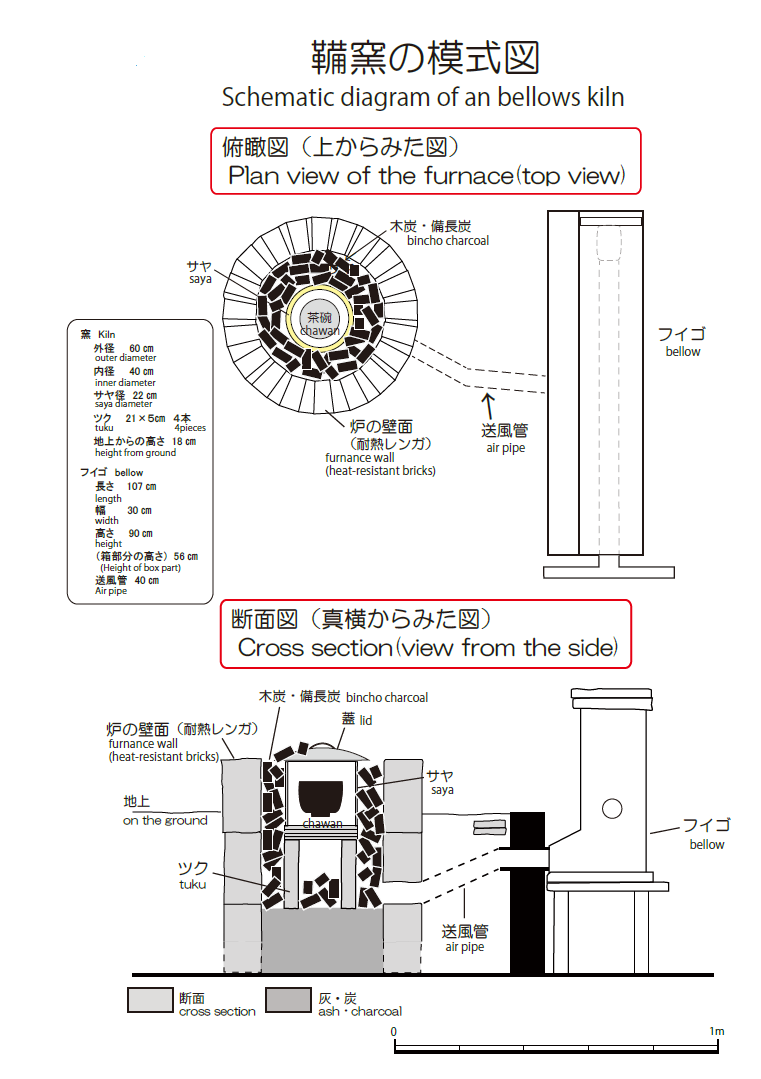
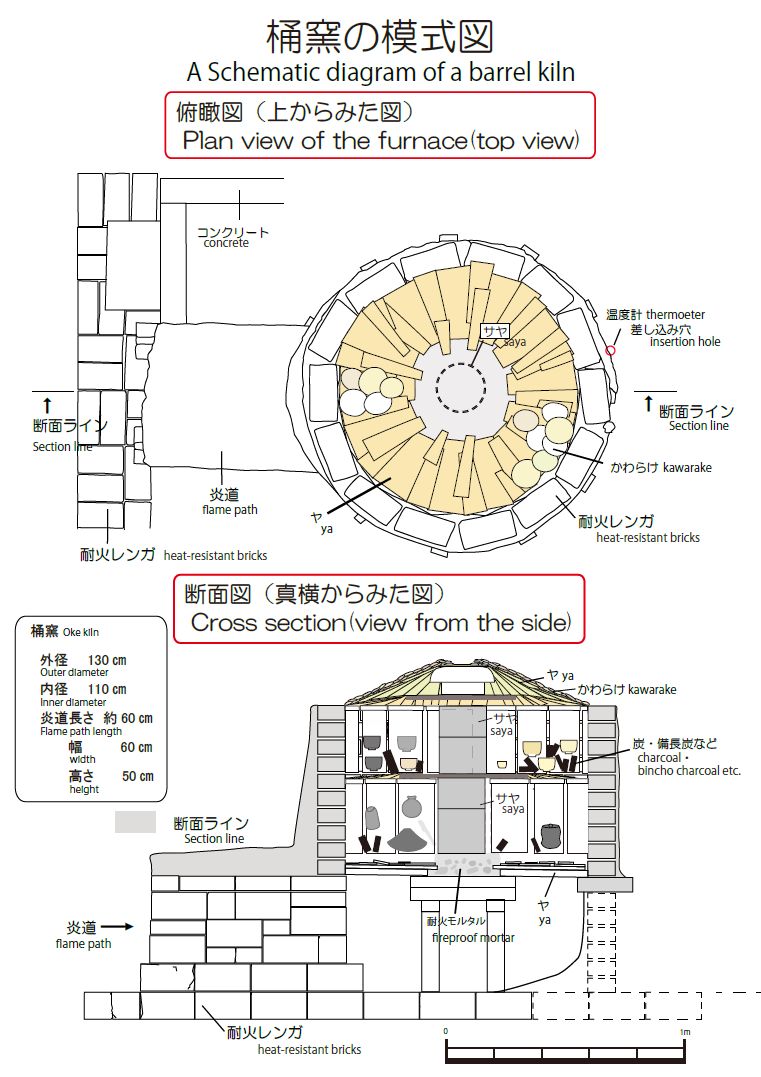
Bellows Kiln and Barrel Kiln

The bellows and cylindrical kilns in the above picture are the replicas of the kilns designed in the Edo period.
The kilns are still used at Kikko Shogetsu.
The bellows kiln on the left is literally a kiln that uses bellows to make products at high temperatures.
The inside of the kiln reaches high temperatures by sending air from wooden box bellows of 107cm in length.
Half of the kiln is under the ground. 

In the bellows kiln, air is delivered from an air pipe buried under the ground by pushing and pulling a handle of box bellows like a piston motion.
A tea bowl is heated in the kiln one by one.
After heated, it is taken out of the kiln with tongs. The Anagama kiln is mainly used for Kuroraku tea bowls.

A barrel kiln is a cylindrical wood-fired kiln that looks like a barrel. In the barrel kiln, firewood or charcoal is used as fuel for Akaraku bowls, vases, and other potteries.
When heating in the kiln, charcoal and/or porcelain chips is/are spread out around products.
By doing so, various accidental colour changes occur. 

The barrel kiln has no lid. Instead, the top of the kiln is covered by lying porcelain chips called “Ya” in a radial manner.
Furthermore, clay potteries called “Kawarake” are layered on the porcelain chips.
For reduction firing, the barrel kiln is designed as flame concentrates on the middle.

Kikko Shougetsu uses not only bellows and barrel kilns but also electric, gas, and kerosene kilns.

鞴窯と桶窯

上記の模式図に見られる鞴窯と桶窯は、江戸時代からの形を復元したもので、現在もこの焼成方法で焼いています。
これらの窯は、楽焼の特徴をよく表しています。
左図の鞴窯は、文字通り鞴を使用した窯で、高火度で焼成する場合に使われる窯です。
鞴の送風で窯内の温度を高温にします。この鞴は長さ107㎝の木製の箱型で、内窯の上部半分を地上に出した半地下形式の窯です。取手を持ってピストン運動をさせ、地中に埋めた送風管から空気の送出を行う仕組みになっています。
内窯には茶碗を1点だけ入れ、焼きあがるタイミングを見て火鋏みで取り出します。主に黒楽茶碗の焼成に使います。
一方の桶窯は、外観が桶のような形をした筒型の薪窯のことです。
薪と炭を燃料とし、赤楽茶碗や花器、その他の作品焼成に使います。
内窯に置いた茶わんの周りに炭や陶片を置くことで、それらによってできる模様「窯変」を作り出しています。
窯の天井は蓋がなく、「ヤ」と呼ばれる陶片を放射状に並べ、その上にカワラケを積み重ねることで天井を塞いでいます。
窯内の炎は中央に寄集する仕組みとなり、還元に近い状態を作り出しています。
吉向松月窯では桶窯・鞴窯の他に、電気窯、ガス窯、灯油窯など数種類の窯での焼成を行っています。


Green Glaze and Hand Building Technique

Jihei Kikko, the founder of Kikko-yaki, used a green glaze to make porcelain products such as a white chrysanthemum, a tortoise, and a food basket with a young pine design.
As mentioned above, Jihei was given a surname “Kikko” because he presented his products to the 11th Shogun of the Tokugawa Shogunate. Therefore, the green glaze is the symbolic colour representing Kikko-yaki.

Successive Kikko-yaki potters attempted to reproduce the green glaze Jihei used in the Edo period.
After long years of trial and error, a new green glaze was finally developed. It is almost the same as the green glaze Jihei used.

Present Kikko-yaki uses a lead-free glaze mixed with copper oxide or chrome.
Thanks to the glaze, a subdued or deep colour can be generated. 

Kikko-yaki insists on “Hand Building Technique”. In the technique, first, coils are made by rolling out pieces of clay carefully.
Second, the coils are stacked and spread with both hands until the clay wall becomes the ideal size.
By repeating those processes, Kikko-yaki can produce round potteries that fit perfectly in people’s hands.
Therefore, it is said that Kikko-yaki’s teacups are designed for anyone to have a cup of tea comfortably.

By blending four types of clay (chamotte, silica sand, frog-eye, and Kibushi clay), furthermore, Kikko-yaki can make products without changing quality of clay.

Kikko Shogetsu’s green glazed potteries have distinctive colour intensity that other potters cannot replicate.
The green glaze derives from the vitreous substance used in Nara three coloured potteries.

Kikko Shogetsu focuses not only on potteries for daily use but also on artworks for ornamental purpose and always challenges new Kikko-yaki while sustaining the traditional pottery making techniques developed by Jihei Kikko and successive potters. 

緑釉と手びねり
 
初代吉向治兵衛が制作した白菊・亀・若松の食籠などに使われれている緑釉は、「吉向」の姓を拝領する縁となった吉向焼を象徴する代表的な色釉です。

江戸時代に誕生した吉向焼は、初代吉向が施した“緑釉”を現代で再現するために、幾度も試行を繰り返しながら、その研究にとても長い年月を費やしました。その結果、当時の緑釉に限りなく近い“緑”の開発に成功し、現在では無鉛釉に酸化銅などを混ぜてくすみや味わいのある色を生み出しています。

また、茶碗の成形は“手びねり”という形に強いこだわりをもち、土玉を両手で丹念に伸ばしながら幾重にも積み重ねていくという方法でおこなっています。
手に馴染む丸味のある形状が飲み良い器作りにつながっています。

さらに、4種の材料をブレンドした土(シャモット・硅砂・蛙目・木節粘土)で素地の質が変わらない陶器を作っています。

吉向松月窯の緑釉施釉陶器は、他では見られない深みのある濃淡が特徴的で、この色は奈良三彩に使われている緑釉がルーツとなっています。初代吉向からの伝統技法を保ちつつ、鑑賞美術陶器などにも力を入れ、新しい形の吉向焼を目指しています。

Kikko-yaki and “Daruma Society”

From the 19th century to the early 20th century, cultural intellectuals in Osaka organised a social gathering club named “Daruma Society”.
It was a club where dandies and stylish people gathered.
“Daruma” is a round doll that does not have hands and legs.
The doll is called “Daruma” because it looks as if Bodhidharma (called “Daruma” in Japan) practices Zazen (sitting mediation). 

In Japan, the word “Ashi (legs)” is often used when describing money.
Thus, “Ashi ga Nai” means “No money”.
The cultural intellectuals who organised the social gathering club were not rich.
Therefore, their club was named “Daruma Society”. 

Kikko the 5th was a member of the club.
Many club members frequently visited him even after his workshop was moved from Kozu Shrine in central Osaka to Okayamate in Hirakata. The members enjoyed Haiku and garden parties at the Kikko’s workshop.

Kikko Shogetsu has a lot of mementos relating to “Daruma Society”.
For example, the double-spouted teapot was used when Bunya Katsura, a Rakugo storyteller, had some water to clear his head after drinking.
A pair of two folding screens titled “Kikko Kiln” (Tatehiko Suga) show a scene where the Kikko-yaki potters are working at the workshop.

吉向焼と「達磨会」
 
明治から昭和初期にかけて大阪の文化人などによるサロン「達磨会」がありました。
“しゃれ者や風流人の集まり”を称したもので、「お金が無い」と「お足がない」を掛けて「達磨会」といいました。
五世吉向松月(吉向萬三郎)は会員でしたので、大阪の高津神社表門から枚方市岡山手に窯を移した後も吉向松月窯には、「達磨会」のメンバーが度々集まり、俳句を詠んだり園遊会を行っていました。
噺家の桂文屋に、酔い覚めの水を飲むのに便利な両口の土瓶の制作を依頼されたり、菅楯彦作の「吉向窯之図」は二曲一隻の屏風絵で、吉向松月窯の工房で働く陶工の様子を描いた作品であったりと、吉向松月窯には、今でも数多くのエピソードやゆかりのあるものをモチーフにした焼き物、絵画、写真などが残されています。